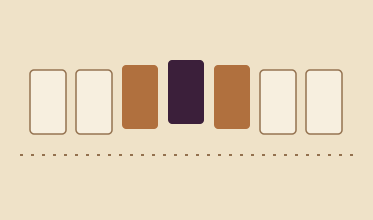
The seven-card spread is the longest layout on this site, and the one people tend to overcomplicate on sight. It isn’t a different method from the two-card or three-card spreads — it’s the same line, just with more positions, useful when a question genuinely has several distinct angles that each deserve their own space instead of being squeezed together.
The Seven Positions
- Where you’ve been. The recent thread leading into the current question.
- Where you stand now. A plain snapshot of the present situation.
- What’s helping you. A resource or strength already working in your favor, even a quiet one.
- What’s working against you. An obstacle, habit, or blind spot worth naming honestly.
- What you’re not seeing. A piece of the picture that hasn’t come into focus yet.
- What’s coming into view. Not a prediction — a read on where things seem to be heading if nothing changes.
- The likely outcome if you stay the current course. A plain read on where the present trajectory leads, framed as information for a decision, not a locked-in fate.
Lay the seven cards left to right in that order. Read positions one through three first as their own short arc, then four through six as a second arc, then let position seven close the line. Breaking a long spread into smaller arcs like this is the difference between an overwhelming pile of cards and a readable story.
When to Reach for This Spread
Save it for questions with real complexity — a career decision that touches money, identity, and timing all at once; a relationship question with a long history behind it. If your question is quick and specific, the two-card check-in or the three-card line will get you a cleaner answer faster. Using seven cards on a simple question doesn’t make the reading more powerful — it just gives you more cards to force a connection between, which tends to produce a muddier read, not a sharper one.
A Worked Example
Question: “Should I take on this new role at work?” Positions one through three might land as the Six of Swords (moving away from a rough patch), the Ten of Pentacles (real stability, maybe more than you’re giving yourself credit for), and the Queen of Wands (a strength around confidence and follow-through). Positions four through six might land as the Eight of Swords (feeling boxed in by rules that may be more assumed than real), the Page of Cups (an emotional angle you haven’t fully looked at — maybe attachment to your current team), and the Wheel of Fortune (a sense that change is already in motion whether you act or not). Position seven — the likely outcome on the current course — might land as the Four of Swords: rest, a pause, things staying essentially as they are for now.
Put together, that’s a reasonably specific picture: you’re more stable and more capable than you’re giving yourself credit for, something is quietly holding you back that may be more habit than real constraint, and staying put means staying in a holding pattern rather than actively regressing. None of that decides the job offer for you — it gives you a clearer set of facts about your own situation to decide with.
Setting Up a Clean Draw
Give yourself real time for this one — ten to fifteen minutes, not two. Lay all seven cards face down in a single row before turning any of them over, so the layout is fixed before you start reacting to individual cards. Read in the three arcs described above, and write one short line after each arc before moving to the next, rather than trying to hold all seven meanings in your head until the end.
- Confirm the question deserves seven cards. If you can restate it as a single clean sentence, a shorter spread will likely serve you better.
- Read each arc before moving to the next. Positions one through three, then four through six, then position seven on its own — don’t skip ahead to the ending.
- Write a one-line summary per arc. Three short sentences are easier to hold onto and compare than seven separate card meanings.
- Expect position seven to describe a trajectory, not a fixed ending. “Where the current path leads” is information you can act on, not a locked outcome.
Frequently Asked Questions
Do I have to use all seven positions every time?
Yes — if a question doesn’t need all seven, that’s a sign to use a shorter spread instead, not to draw seven cards and only read three of them. Consistency in how you use each layout is part of what keeps the method trustworthy.
This feels like a lot to hold in my head — is that normal?
Very normal, and the fix is structural, not about memory: read it in the three smaller arcs described above instead of all seven cards as one flat list. Writing down a single line for each arc as you go helps more than trying to hold the whole spread in your head at once.
Can this spread tell me exactly when something will happen?
No. More positions give you more angles on a situation, not a calendar. Treat position seven as “where the current path leads,” not a date on it. See the disclaimer for how this site frames timing and outcomes generally.
What’s the difference between this and the three-card line?
Same method, more room. The three-card spread covers past, present, and next step in one pass; this one splits that same arc into finer positions and adds a look at strengths, blind spots, and a likely-outcome read. Use the size that matches your question, as described on the Nightgate Tarot homepage.