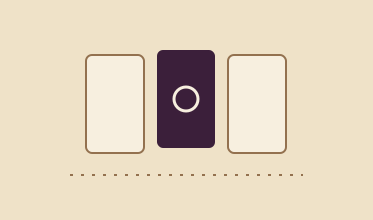
The three-card line is the workhorse spread on this site — the one to reach for when you don’t have a more specific layout in mind. Three positions, read left to right as a single line rather than three unrelated fortunes, cover most open-ended questions without over-complicating the draw.
The Three Positions
- Past — what led here. Not a full biography, just the recent thread that’s most relevant to the question you asked.
- Present — where things actually stand. A plain snapshot of the situation as it is today, not as you’re hoping it will look.
- Next step — what’s asking for attention. Not a prediction of what will happen, but a plain read on what the situation seems to be asking of you next.
Read them as a line: “this led here, this is where things stand, and this is what’s asking for attention.” The connective thread between the three cards usually tells you more than any one card read alone.
Choosing This Spread Over the Others
If your question is small and fast, the two-card check-in is a better fit. If it has several distinct angles that genuinely need their own space — say, a decision that touches money, timing, and a relationship all at once — the seven-card spread gives each one room. The three-card line sits in the middle: broad enough to cover most everyday questions, focused enough to stay readable in under five minutes.
A Worked Example
Question: “What should I understand about this move to a new city before I commit?” Past: the Eight of Cups, walking away from something that had stopped serving you. Present: the Nine of Pentacles, a period of relative stability and self-reliance. Next step: the Two of Wands, standing at a genuine fork with a map in hand rather than a clear signpost.
Read as a line: you left something behind for good reason, you’ve built some real stability since, and the next step is a genuine choice between two live options rather than a single obvious path. Nothing here says “move” or “stay” — it names the shape of the decision so you can make it with your eyes open, rather than out of restlessness or fear.
Reading the Cards Together, Not Separately
The most common beginner mistake with this spread is reading each card as its own isolated fortune — “the past card means X, the present card means Y” — and stopping there. The method only works when you connect them: does the present card resolve the tension from the past card, or extend it? Does the next-step card offer a way through what the present card names, or does it point somewhere else entirely? Those relationships are where the useful read actually lives.
Setting Up a Clean Draw
A three-card line works best when you resist the urge to peek ahead. Lay all three cards face down first, in order, then turn them over one at a time, reading each position fully before moving to the next. Flipping all three at once tends to collapse the reading into a single flat impression instead of a line you can trace from card to card.
- State the question before you shuffle. “What should I understand about X” works better across all three positions than a question that only fits the “next step” slot.
- Read left to right, not by card strength. Start with the past card even if the present card feels more dramatic — the order carries meaning on its own.
- Name the connective thread out loud. After reading all three individually, say one sentence that ties them together. If you can’t find that sentence, sit with the spread a little longer before moving on.
- Resist redrawing a card you don’t like. A card that feels off often carries the most useful information in the whole spread.
Frequently Asked Questions
Does “past” mean years ago or last week?
Whichever timeframe is actually relevant to your question — there’s no fixed window. For most questions, “past” means the recent chain of events that led directly to where you’re standing now, not your entire life story.
Can I use this spread for someone else’s situation?
You can draw about your own perspective on someone else’s situation — how you feel about a friend’s decision, for instance — but the reading still reflects your view, not a report on their private thoughts or plans.
What if the “next step” card contradicts what I actually want to do?
That’s worth sitting with rather than dismissing, but it isn’t binding. The card names one way of reading your situation — you’re still the one deciding what to do with that read. See the disclaimer for how we frame the limits of any spread.
Is a three-card spread “less accurate” than a seven-card one?
No — accuracy isn’t really the right frame for either. More positions give a question with several angles more room to be examined; they don’t make a simpler question more “correct.” Pick the size of spread that matches the size of the question, described on the Nightgate Tarot homepage, and try the quick love spread if your question is specifically about a relationship.
Can I use three cards for a career question specifically?
Yes — the three-card line handles career questions well, since most of them boil down to a clean past/present/next-step shape: what led to this point at work, where things actually stand today, and what the situation seems to be asking of you next. It’s a good default before reaching for the longer seven-card spread, which is worth the extra positions only once a career question genuinely splits into several distinct threads — money, timing, and relationships with coworkers all at once, for instance.